Thursday, 18 March 2010

3) What kind of Media Institution might distribute your Media Product and why?

Our film would be distributed by a company such as Fox Searchlight because they are associated with smaller films.


Other films Fox Searchlight have distributed are:
  • Adam


  • Juno

  • 500 Days of Summer

  • Slumdog Millionaire


Fox Searchlight distribute unique and distinct films that introduce new actors.

Our media product, An Eye for an Eye, does not classify into a particular genre of film. The storyline is slightly unconventional and there is elements of Drama, Sport and Crime conventions.

Fox Searchlight, or another independent company, would be more suitable and likely to distribute our film due to the unconventional approach we took in creating our media product.

Our film would also have to have a low budget meaning we would have an independent company distributing our product.

Never Back Down, is a sporting film similar to our media product. This film was distributed by Momentum Pictures and Universal Studios.

These companies are leading companies in the UK (momentum pictures) and the USA (universal studios). If our film was of a higher budget, these companies would be appropriate to distribute our media product as they distribute all genres of films, including films like Never Back Down, which are a similar genre to our product.

2) How does your Media Product represent particular social groups?

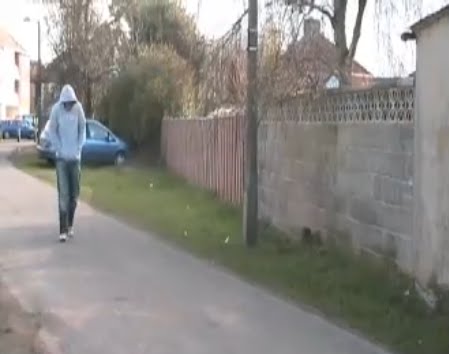
In our film opening sequence, only the main character, Owen Haynes, is introduced. He first appears putting tape on his hands and then shortly after, boxing. This has particular relevance to the film and the character, as it represents the violence and aggression involved. Owen Haynes is not representing a clear and defined social group, but he is representing young, sporty men from a working-class background. He is stereotypical as he is interested in sport and fighting, and he wears a hoody. The mise-on-scene too, is a typical place for the character to be. Owen Haynes is walking down an alley way. Alleys have a lot of connotations, mainly involving crime. In addition, Owen's character himself could be a connotation of the alley way. Throughout the opening sequence, we do not see Owen Haynes' face. This gives him a more mysterious look and adds danger to him. It again, contributes to the representation of his social group. There is not one specific film genre that our film would class as, so the representations in our film is not typical for it. Furthermore, I do not think that our character of Owen Haynes is typical for any film genre.

1) In what ways does your Media Product use, develop or challenge forms and conventions of real Media Products?

Our opening sequence uses many conventions of film opening sequences; we looked at opening sequences such as Green Street, Dead Man's Shoes, Snatch and Legally Blonde.


Through watching these, we established some of the main conventions of film opening sequences. We believed that the main conventions of the beginning of a film were:


Introducing characters - We have introduced our main character, Owen Haynes, through the use of voiceover and his boxing image. The main focus of our sequence was to present Owen to the audience to incorporate his way of life and his childhood difficulties. We changed the accent and native of Owen from Cockney/English to Irish as we believed that the Irish accent put on by our actor, Toby Zahiri-Sellers, sounded more 'thuggish' and fitted with his character and appearance.

Introducing Story Line - This was also shown through the use of the voiceover. The voiceover explains the main plot of the entire production; it projects Owen's childhood, his path to boxing and implies his misdemeanors-


''My name is Owen Haynes. Last summer something happened in my life to make me realise I gotta make something of myself; my mate, Danny, from school, convinced me to join his gym. Little did I know it was specialised in boxing. Boxing really wasn't my thing, you only had to look at me to know that; when I started I was the same small, scrawny little bastard as I was when I was a kid. I was constantly looking over my shoulder, I didn't think that anything could be worse than my childhood. I always wanted to get something out of life, i think now is the time for that to happen..."

Our voiceover was inspired by the voiceover of Elijah Wood's character Matt Buckner in Green Street. We thought that it was a clever way of introducing the actions and thoughts of the character.

Introducing setting (through use of mise-en-scene) - We used two settings in our opening sequence to help portray elements of our character; the gym and the alley way. The gym helped give a sense of the character's background via his personality and hobby of boxing. Also, the gym helps foreshadow the violence that would happen later on in the film. In addition, the alley way is in association with crime, drugs, etc which helps define Owen Haynes' character and hometown.


Grab Audience's Attention - In order to grab the audience's attention, we covered up the face of our main character to present the character in a mysterious manner. In the voiceover, there were things about Owen that were revealed but not everything as this also adds to the mystery of his character and this makes the audience want to find out more about him.

Genre - Our film opening sequence consists of various genres.
These include:
Drama
Sport
Crime

Eye For An Eye Final Cut

Editing Images


These are some images of some of editing we did.


Editing

The first stage of our editing was cutting all the parts of the footage that were not useable out. We were then left with the correct amount of footage. We put it all in order to match the sequence on the storyboard. We had to adapt the order due to the changes we then needed to make on the storyboard.
We then added in the titles to the sequence on Final Cut Pro. We originally had these over the footage but some of the shots did not flow and we did not want to over use the fading effect. We moved them to in between shots and this made the shot transitions clearer.
After all the shots were in order we started adding the effects. We wanted the child scenes to look as though they were a dream from the past. The best way to achieve this was to add an additive fade in fade out effect. Also to make sure it was clear these shots were from the past we added a black and white effect. This is a traditional use of effect to show past events.
We put the production logos at the front as this is the place in which they go in films that have been released.
Once we were happy with the sequence we then worked on the soundtrack. We used Soundtrack Pro to create a simple piece of music to go beneath the voiceover. We used You OK and Distorted Portamento 1. These two sound effects create the music throughout the whole open sequence. For the Eyeline Studio Production logo we used Computer Data 2 for when the white part of the eye moves. For the Draak Production logo we used Dinosaur Growl and Explosion Blast 4.
We recorded the voiceover straight onto Final Cut Pro. We recorded the monologue in separate sections so we could have the voice throughout the whole sequence. This allowed us to put the correct part of the monologue over the child scenes. Also we could put the end of the monologue on the end shot so the voiceover finishes as the footage fades out.

Adaption of the Storyboard

Once we had all the footage in the correct order we found that the sequence did not work as well as we planned. The scenes including the victim being punched and killed made the story line unclear to the audience. It was hard to portray how the victim linked into the main character's life.
We attempted having a match on action shot in two of the shots. One was in the child scene, where he walks down the alley. We wanted to show him from the front and then the back. This made the sequence of him walking too long of just one element, therefore boring and less entertaining for the audience. The second shot was where our main character goes to punch a punchbag and the match on action shot shows him punching the victim. We had to take this out due to the confusion in the storyboard, also it was difficult to make it flow seamlessly with the resources we had available.
We decided to have all the child scenes next to each other because we wanted a certain part of the voiceover to play alongside it. This part of the voiceover makes it clear to the audience that the child is our main character in the past.